
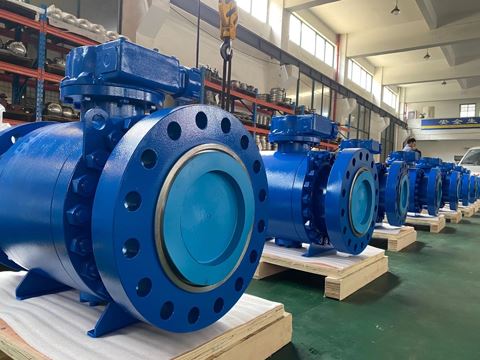
A ball valve is a form of quarter-turn shut-off valve that controls the flow of a liquid or gas by means of a rotary ball with a hole bored through the center and sandwiched between two seats. Like one piece or single body ball valve,two piece ball valve,three piece body ball valve,top entry ball valve,side entry ball valves,welded body ball valves. Ball valves do not use a hand-wheel but instead use a wrench handle to control the flow. A 90°turn of the wrench opens or closes the valve. It is open when the ball’s hole is in line with the fluid flow direction and closed when it is pivoted 90-degrees by the valve handle. The handle lies flat in alignment with the flow when open, and is perpendicular to it when closed, making for easy visual confirmation of the valve’s status.
Ball valves are characterized by a long service life and provide a reliable sealing over the life span, even when the valve is not in use for a long time. As a result, they are more popular as a shut-off valve then for example the Gate Valve or the Globe Valve. Moreover, they are more resistant against contaminated media than most other types of valves. Ball valves can be driven manually, electrically or pneumatically.
Advantages and Disadvantages
Advantages:
Ball valve ensures a reliable sealing even in the case of dirty media.
Ball valve structure is simple, the weight and volume are relatively small, and it is easy to disassemble and repair.
As the ball valve stem only rotates with no axial movement, the packing seal of the valve stem is not easily broken.
When fully open, a ball valve creates little turbulence or resistance to fluid flow.
Operating ball valve is simple and quick as it only needs to be rotated by 90° from full opening to full closing. Such quick opening and closing of a ball valve may be of importance in some installations where isolating pipe sections quickly is needed in the event of emergency.
Ball valves are considered high recovery valves, having a low pressure drop and relatively high flow capacity.
Disadvantages:
The ball valve can only be fully open or fully closed and cannot be used for throttling. This is because of the relatively limited accuracy of controlling the flow rate.
Not suitable for slurry applications due to cavities around the ball and seats. Slurries tend to solidify or clog inside the cavities, greatly increasing the operating torque of the valve and in some cases rendering the valve inoperable.
Since ball valves open and close so quickly, ball valves may induce water hammer or surge pressures.
The hollow ball may trap fluid in the closed position and may cause problems if the valve body is not vented.
Abrasive solids suspended in the fluid flow may damage the seats and ball surface because the ball moves across the seats with a wiping motion.
May be difficult to clean (except for top entry design).